
Achieving business success today increasingly depends on getting the right information at the right time — so people can make decisions at the speed of business and intelligent agents can take the right actions. For data, analytics, and AI agents and people to work effectively, organizations need data that is consistent, trusted, and high quality. Equally important is a clear map of how that data can be discovered, accessed, and used. Without this foundation, it is extremely difficult to deliver self-service business intelligence or enable reliable, agent-driven processes.
According to Saul Judah, Distinguished Analyst at Dresner Advisory Services, “finding the right data and analytics assets in the right context is a prerequisite for BI success. When users can easily discover and access the data they need for their business context, organizations are far more likely to generate actionable insights and deliver meaningful BI and AI outcomes.” Yet, many organizations struggle with a persistent gap between what business leaders need to run the business effectively and what data and analytics teams actually provide. This disconnect often limits the value organizations realize from their data investments.
One major reason for this gap is the absence of a formal data and analytics governance framework. Without such a framework, organizations lack the policies, roles, and processes needed to ensure that data assets are reliable, discoverable, and aligned with business priorities. The result is slower progress on data and analytics initiatives and increased exposure to business and operational risk. Judah notes that this issue is reflected in Dresner’s 2025 “Data and Analytics Governance Study.” The research found that only 41% of organizations have a formal governance framework in place.
Among organizations reporting that their BI initiatives are completely successful, 46% have formal governance established. By contrast, only 27% of organizations with somewhat unsuccessful BI initiatives have governance in place. The value of formalizing governance is clear. Organizations reporting the greatest BI success are also far more likely to say that users — or agents — find it “relatively easy” or “extremely easy” to locate the data and analytics assets needed to inform business decisions.
Without effective governance, organizations struggle to deliver and sustain the data, analytics, and AI assets required to meet business needs. Too often, they try to compensate by investing in additional tools and technologies, assuming the tools alone will solve the problem. In reality, adding more technology rarely helps in the absence of governance. As CIOs frequently note, fixing data challenges requires attention to people, process, and technology — in that order. Organizations that take a technology-first approach are typically at lower levels of data and analytics maturity, lacking the processes and organizational discipline needed to ensure data investments are delivered and maintained over time.
Another common mistake is implementing fragmented governance based on a company’s operating model. Some organizations establish separate, asset-type-specific governance structures for data, analytics, content, or AI, effectively creating governance silos. These bodies often sit in different parts of the organization, are led by different executives, and follow different business priorities and rules. The result is inconsistency in how data and analytics assets are managed across the enterprise. Equally problematic is governance that is overly technical or narrowly focused on risk and compliance. While these perspectives are important, governance that centers only on technology or risk fails to address the broader business value of data and analytics. The ultimate goal of a governance framework should be to serve the organization’s business needs — ensuring that data, analytics, and AI capabilities are aligned with how the business operates and creates value, not just with the needs of IT or data teams.
The Process Forward
Organizations seeking meaningful AI, data, and analytics outcomes should begin by adopting the Dresner Advisory Services AI, Data, and Analytics Governance Framework as the foundation of their governance strategy. This unified framework provides the structure needed to align data, analytics, and AI initiatives while establishing consistency, accountability, and trust across the organization.
The first step is to assess the current state of governance. Organizations should evaluate how formal their existing data and analytics governance programs are and whether they can scale to support strategic business objectives. This assessment should identify the key data and analytics assets required for priority business use cases and determine whether those assets fall within the scope of the current governance program.
With this baseline established, the framework can then be used to identify gaps between existing governance capabilities and what is required to meet business expectations. These insights highlight where governance processes, policies, and oversight must evolve to support reliable AI, data, and analytics initiatives. Next, organizations should establish investment priorities by engaging business leaders and data and analytics teams. Together, they should identify the governance capabilities that will have the greatest impact on business outcomes. These priorities inform a strategic roadmap that guides the evolution of the governance program.
Finally, governance structures and supporting technologies should be aligned with the roadmap. Organizations must establish clear roles and responsibilities, adjust the organizational model where necessary, and evaluate the governance technology landscape. Reducing tool proliferation and optimizing the technology portfolio ensures that governance capabilities remain efficient, scalable, and focused on delivering business value.
AI, Data and Analytics Governance Framework
According to Jonathan Reichental, former CIO for the City of Palo Alto and author of “Data Governance for Dummies,” organizations cannot succeed with data governance through isolated actions or tools. Regardless of how extensively governance practices are implemented, they must begin with a clear set of guiding concepts and a structure in which those concepts are applied. That structure is the AI, data, and analytics governance framework — the foundation that organizes governance assets and efforts and ensures they are applied consistently across the enterprise.
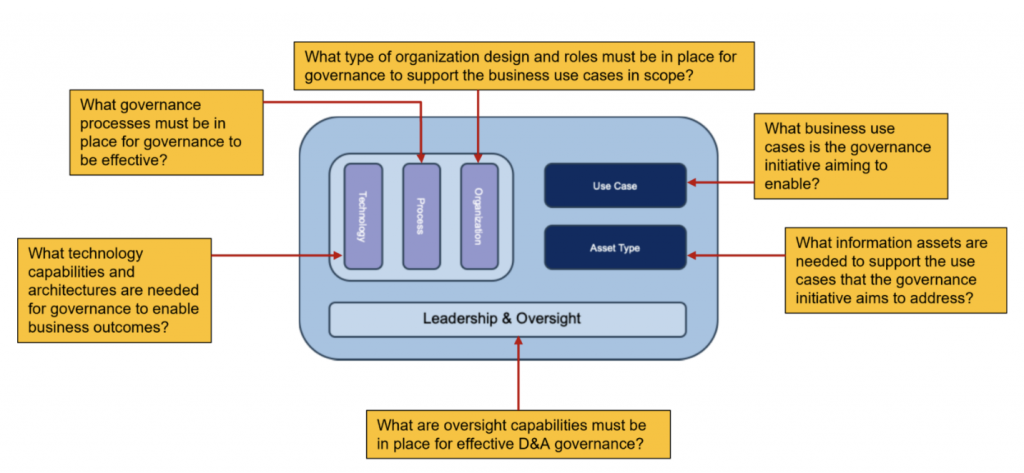
An effective framework must address the three core dimensions of governance: people, processes, and technology. Its purpose is to secure senior leadership support and align governance activities across the organization. A strong framework identifies and empowers the right participants with clear responsibilities, establishes and enforces policies and standards, measures and reports on governance performance, and deploys tools that support governance activities. Just as importantly, it enables ongoing communication and collaboration between the business and technology stakeholders responsible for managing and using data, analytics, and AI.
The Dresner Advisory Services AI, Data, and Analytics Governance Framework take a business-first approach by directing governance efforts toward enabling specific business outcomes. Rather than treating governance as a purely technical discipline, the framework focuses on how AI, data, and analytics assets support the organization’s strategic objectives and operational priorities.
At the center of the framework are business use cases. Organizations ultimately exist to achieve measurable outcomes — such as cost optimization, improved customer experience, innovation, and regulatory compliance. These outcomes are realized through specific use cases that define how the business creates value. By understanding these use cases — and the metrics used to measure success — governance efforts can prioritize the assets and initiatives that matter most to the business.
The framework also recognizes that most use cases rely on a combination of asset types, including data, analytics, AI models, and other forms of content. Mapping these critical assets to business use cases allows organizations to focus on governance where it will have the greatest impact. This alignment ensures that the most important information assets receive the appropriate levels of quality management, oversight, and protection.
Effective governance also requires leadership and oversight. “Governance initiatives do not emerge organically; they must be authorized and guided by executive leadership”, says Judah. Governance leaders define the scope of governance, establish accountability and decision rights, and set priorities for the AI, data, and analytics assets that support business goals.
Because governance is ultimately carried out by people, the framework emphasizes organizational structure. Governance activities occur across the enterprise and require collaboration among business leaders, data stewards, analysts, and technologists. Clear organizational design determines where governance activities take place and assigns the roles and responsibilities needed to support business objectives within the governance scope.
Governance must also be embedded in processes. Rather than being treated as a one-time initiative, governance should function as a continuous system that integrates decision-making into everyday business workflows. Well-defined processes allow governance participants to coordinate activities, communicate effectively, and manage exceptions when policies or standards require review.
Finally, governance depends on technology that can operate at an enterprise scale. AI, data, and analytics assets are created, accessed, and managed across the organization, making technology essential for enabling governance activities. Governance technologies help identify and catalog information assets, track their meaning and lineage, measure their quality and consistency, and control who can access them. They also provide the security and controls needed to protect sensitive information.
Together, these components provide organizations with a practical blueprint for governing AI, data, and analytics assets and initiatives. The framework helps organizations establish the oversight, organizational structures, processes, and technologies required to manage information assets in support of specific business use cases. At the same time, vendors offering governance solutions can use the framework to understand how their offerings fit within an organization’s governance landscape and identify potential gaps in their capabilities.
Parting Words
Ultimately, organizations that succeed with AI, data, and analytics recognize that governance is not a bureaucratic exercise — it is a business capability. A well-defined governance framework creates the structure needed to align information assets with real business outcomes, ensuring that the right data, analytics, and AI models are trusted, accessible, and used responsibly. As organizations scale their use of intelligent agents and data-driven decision-making, the importance of governance only grows. Those that invest in a unified, business-centered governance framework will be far better positioned to close the gap between data potential and business value — turning information into a durable competitive advantage.
