
I’ve read a bunch of books on data literacy over the years. I’m a data person, so I get data, but I find reading data literacy books helps me explain what data is and why it is important to people who aren’t data geeks. I admit sometimes I am in the data weeds too much, and try to find new ways to explain why data is so important to someone who does not have “data” in their job title, like my kids, neighbors, or older relatives.
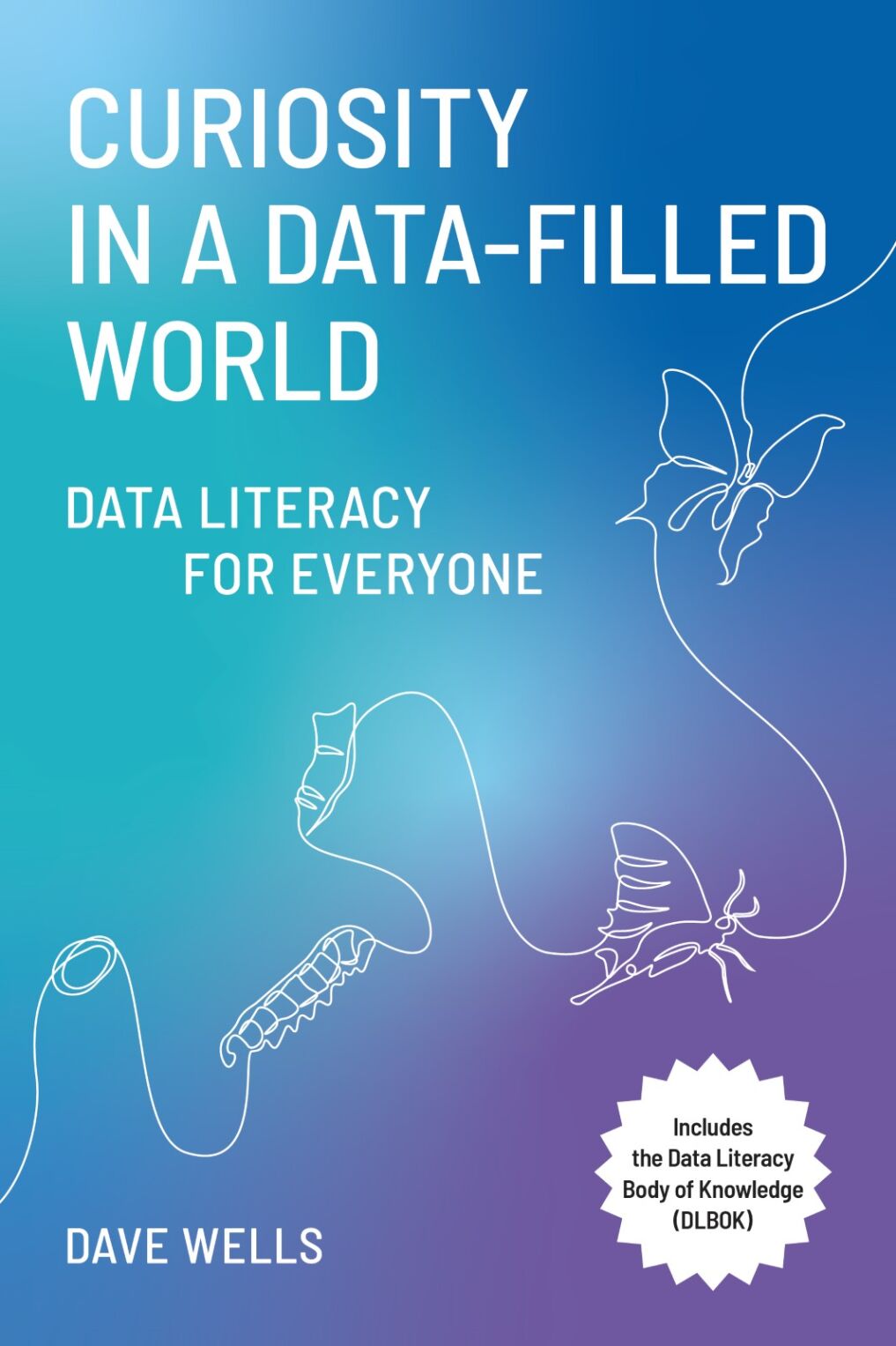
“Curiosity in a Data-Filled World” by Dave Wells does an amazing job of explaining why data is important and, in addition, why it is critical today to be a questioning person. That is, questioning survey results, what a marketing organization is going to do with your personal information, and how AI is using your data to help others make decisions that can impact you.
The book is practical and for ordinary people, not just analysts, programmers, or statisticians. The book stresses data literacy as a life skill, as basic in modern life as reading and writing, because people constantly encounter numbers, scores, rankings, dashboards, recommendations, and records in daily routines. It is for a broad audience: parents, students, workers, managers, and citizens who want to make better decisions and ask better questions in a world shaped by data. Rather than getting into the data weeds, the book emphasizes awareness, judgment, curiosity, and everyday reasoning.
Chapter 1 explains that data literacy begins with noticing how much data has entered everyday life. Receipts, nutrition labels, grades, credit scores, apps, and AI recommendations are all part of our daily experience. Data literacy is not only about charts, dashboards, or workplace analytics. It includes the ability to interpret, question, and think with data in personal, civic, and family settings.
Chapter 2 looks at three perspectives on the same skill: personal, work, and societal. Personally, data shapes choices about money, health, and time. At work, it helps people coordinate action and carries responsibilities such as fairness and confidentiality. In public life, data shapes opinion, policy, and trust.
Chapter 3 shifts into practice by defining data as recorded experience rather than abstract numbers. Meaning comes from context, not just from counts. This chapter is really about learning to notice patterns without overreacting to isolated numbers.
Chapter 4 is about skepticism. That is, how to move from data to evidence, how to distinguish correlation from causation, and how bias and misleading visuals distort interpretation. This chapter stresses that ethics and power cannot be separated from data, since institutions decide what gets counted and what decisions get made based on the data.
Chapter 5 focuses on decision making. Data matters most when it affects action, but it never acts alone. Good decisions blend information with judgment, values, and experience. This chapter walks through family choices, workplace decisions, and civic choices, while also stressing that people must evaluate the quality of the data itself and learn from outcomes afterward.
Chapter 6 turns to communication. Data only gains influence when it is shared in a way others can understand. This chapter covers selecting relevant information, shaping a message for a specific audience, using visuals honestly, and explaining meaning with words. Communication is not a final presentation, but a conversation that improves understanding through feedback and listening.
Chapter 7 states that data literacy begins in childhood. Counting, sorting, fairness, and simple error-checking are early forms of data thinking. As students grow, they can learn to question numbers, interpret visuals, and connect evidence to local issues. See how schools, libraries, and youth programs can help children become confident, curious, and thoughtful users of information rather than passive consumers.
Chapter 8 brings the discussion into households and neighborhoods. Parents, caregivers, shoppers, patients, voters, and volunteers all work with data, even if they do not call it that. This chapter explores school portals, medical information, reviews, rankings, public headlines, and local participation. To stay curious, we need to ask what is being measured, who benefits, and whether a statement deserves trust.
Chapter 9 broadens the discussion to work and public life. This chapter covers service work, trades, office roles, management, education, and policymaking. In each setting, data literacy involves interpreting information responsibly, recognizing uncertainty, communicating clearly, and handling sensitive data carefully. As responsibility rises, so do the stakes, but the same habits remain at the center.
Chapter 10 focuses on technical and digital systems roles. This chapter stresses that software teams, data professionals, and governance or privacy specialists all shape how data flows, how it is represented, and how it affects real people. Technical work is never only technical; it also involves ethics, accountability, shared definitions, and human impact.
Chapter 11 gathers the book’s recurring habits together: counting, classifying, comparing, spotting patterns, and turning information into insight. These appear as practical, repeatable moves that show up in everyday moments, from reading a bill to evaluating a headline. The chapter gives the book a unifying structure by showing that data literacy grows through repeated practice rather than specialized expertise.
Chapter 12 closes on a reflective note. Data literacy becomes not just a skill set, but a way of seeing, thinking, learning, connecting, and growing over time. Curiosity keeps the process alive, while experience and reflection deepen it.
I know Dave well, and I know that, even after writing the manuscript, he read and reread every sentence, thinking, “Would someone who has no or minimal knowledge of data (but uses and is impacted by data all the time) benefit from this book?” I know he achieved this goal. If you are a data person, read this book to get out of the weeds and become competent in explaining data, its importance, and its impact to a non-data audience. If you are a member of the non-data-audience, this book will increase your awareness and curiosity of our data world.